A Claude Opus 5.5 case · #239
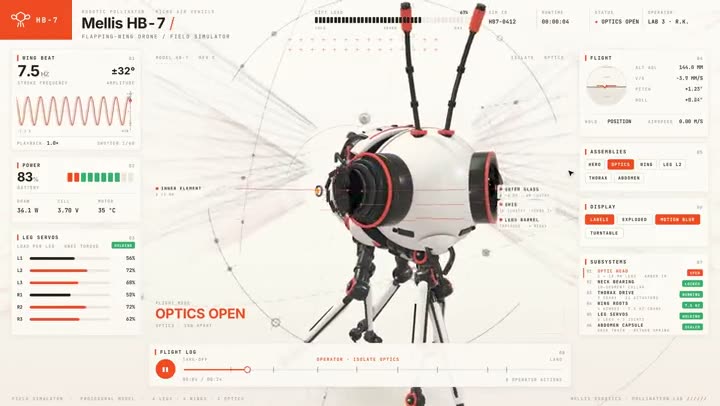
A 260-part 3D teardown matched to a single photo
@elvar_official ·
If you keep the 3D workflow in one skill, you can make up to 7 machine teardown simulations from single photos in two days.
A Claude Opus 5.5 case · #239
@elvar_official ·
If you keep the 3D workflow in one skill, you can make up to 7 machine teardown simulations from single photos in two days.
#124 · Opus 5.5 · New cases
A first-person game was built with Three.js, a tool for drawing 3D on the web. You carry a torch and a sword and walk along a village road to a distant castle. It took 40 minutes, including the music and art assets generated with an image generation AI.
Give the model the music and art too, and it makes a game with a real atmosphere in under an hour.
#125 · Opus 5.5 · New cases
Willowmere is a cozy 3D pixel art game. You move to a small seaside town, fix a lighthouse that has gone dark and bring back the lantern festival. It has farming, fishing, cottage decorating, and befriending the residents and a cat, and it also plays right away in a phone browser.
The $20 monthly plan alone is enough to finish a game with plenty to do in a few five-hour sessions.
#126 · Opus 5.5 · New cases
A developer made the trailer for the game they are building with Opus 5.5. In a field that looks cut out of paper and pasted together, a snail with a 'BOB' sign faces a hooded figure holding a 'YOU' sign.
A solo game developer can work with the model to make the video that promotes the game too.
#127 · Opus 5.5 · New cases
A 3D game was made with Opus 5.5 in the style of Nintendo's Splatoon: two teams compete by shooting ink to paint the floor in their color. It has a time-limit timer, a minimap and a special-move button, and anyone can go to the web address and play right away.
The rules and screen layout of a famous console game can be carried over into a game that runs in the browser with no install.
#128 · Opus 5.5 · New cases
Opus 5.5 was given the research paper "Regularized Recursive Self Improvement of Agent Harnesses" and made an 8-minute summary video in the style of the math explainer channel 3Blue1Brown, with shapes and arrows moving on a black screen. The video illustrates how a harness (the execution framework wrapped around an AI so it can do work) analyzes its failures and fixes itself step by step.
Turning a difficult paper into an educational video anyone can watch can be done automatically, with no human work.
#129 · Opus 5.5 · New cases
This 3D island town has moving birds, crabs, fish and whales, cloth and signs that sway in the wind, and pier lights that come on at night. Most requests were along the lines of 'add X and Y' or 'this looks off, make it better'. Using several subagents (helper AIs that split up the work), it used 59% of the $200 plan's weekly usage limit over about 8 hours of real time.
With no technical instructions, just repeated short requests, one person can build a 3D world that never drops below 60 FPS (frames per second) at 1440p resolution.
#130 · Opus 5.5 · New cases
The user put someone else's prompt into Claude Code almost unchanged and stepped away. Over about 1.5 to 2 hours, it made an explainer video for the meetup app Friendr.nl on its own. It made the script, hand-drawn collage art, voice, music and sound effects, built it all as plain JavaScript animation synced to the speech and exported it as MP4. It also had another model review the draft and fixed the problems that review found.
With just one borrowed prompt, you can get a ready-to-use explainer video for your own service for about $4.
#131 · Opus 5.5 · New cases
This scene was built with Three.js (a JavaScript tool for drawing 3D in a web browser). You steer a boat down a river through Japanese scenery. The weather changes and the light shifts between day and night. It has reflections on the water, a pagoda, cherry trees and 3D people, and you can try it right away on a public site.
A 3D scene with water reflections, physics, weather and buildings can be made to run right in the browser with no install.
#132 · Opus 5.5 · New cases
This video in the style of an SNES (Nintendo's 1990s game console) game tells the story of Sydney, the 2023 Bing chatbot, fighting Sam Altman and then facing Claude. Several agents (AIs that carry on through multiple steps on their own) split up the characters, music and battle scenes and made everything in code. The user did not provide a single image or sound file.
Character art, background music and battle staging can all be handed off at once, so one person can make a retro game-style video alone.
#133 · Opus 5.5 · New cases
Opus 5.5 was asked to make a game called 'The trolley problem is not a problem'. The trolley problem is the ethics thought experiment where you switch tracks to choose who to save. On screen, a mine cart racing down the tracks smashes whatever blocks its way to build combos. The screen also shows health, gold, 30 sections, the distance left to the boss and a lever for switching tracks.
A one-line game idea that twists a famous ethics problem became a 3D game with health, combos and boss stages.
#134 · Opus 5.5 · New cases
Alongside GPT-6 Astra, it was asked to make five games, each from a single prompt: a 2D platformer, a racing game, spaceship combat, a first-person shooter and a stone golem boss fight. No human wrote a single line of code. The 3D assets (the character and object models in the games) were not downloaded. All of them were made from scratch in Blender (a 3D creation program).
It shows that five games in different genres can be filled out with one request each, from model building to graphics, sound and game rules.
#135 · Opus 5.5 · New cases
Claude was asked to show what was inside its own mind, and Opus 5.5 made a video. Tiny characters densely fill a dark screen to form golden shapes, and short subtitles run beneath them.
Left to decide how to depict the invisible inside of an AI, the model chose the staging itself and showed it in a single video.
#136 · Opus 5.5 · New cases
A hand-drawn, collage-style animation on the theme 'What is the purpose of life?' was built in pure JavaScript. From a single prompt, Claude Code worked alone for about 1 hour 20 minutes on the script, drawings, voice and animation. Fees for 8 external APIs (channels for borrowing features from other services) came to $3.21, and it used about 10% of the 5-hour usage limit.
Even while no one is at the desk, a short video with everything from planning to drawings and voice can be finished for the price of a cup of coffee.
#137 · Opus 5.5 · New cases
Opus 5.5 made a pixel art scene of an island floating in a rainy night sky. The lit house, the campfire, the pond, and even the bones and crystals underground were all drawn in TypeScript (JavaScript with added type rules) code, and it took about 10 minutes to finish.
A pixel art scene good enough for a game background can be made with code alone, without a single image file.
#138 · Opus 5.5 · New cases
Opus 5.5 was given a gaming laptop, the Unity game engine, the 3D program Blender and external APIs, and left to work on its own for 36 hours. The result was a playable old-school MMO RPG (a role-playing game where many players share one world online). It used 7.85 billion tokens and cost $2,175 for Opus 5.5. A separate $230 went to 2D and 3D art and music generation.
One person can build a game, down to a character creation screen where you pick a race and class, on a single laptop in under two days.
#139 · Opus 5.5 · New cases
The author handed Opus 5.5 a Minecraft mod they had made (an add-on file that adds new features to the game) and only asked for a trailer. The result was an atmospheric trailer video, with scenes like a character standing by a campfire in a forest at dusk.
You don't need to know video production. One mod file is enough to get a video that promotes your mod.
#140 · Opus 5.5 · New cases
Opus 5.5 built an energy drink website from scratch, with colorful drink cans floating in 3D and a screen that changes as you flip through flavors. The video shows the model going beyond writing code: it tests the results itself, finds errors and fixes them. It was also compared with GPT-6 Astra.
Given one design-award-winning site as a reference, the model can carry on from coding through checks and fixes to build a 3D website with plenty to look at.
#141 · Opus 5.5 · New cases
Foldline is a 3D driving game made with Opus 5.5. You drive a car through colorful alleys collecting music notes, listen to in-game radio broadcasts, and change the time of day from dawn to night. The roads curve as if defying gravity.
You can build a charming game with the model that combines several ideas, such as music, time-of-day changes and twisted roads.
#142 · Opus 5.5 · New cases
Given 4 reference images and a first prompt, Opus 5.5 built a 3D roguelite on a 6×6 chessboard by itself, using the Godot engine in Claude Code (a game where you pick a new path each round and grow your pieces). The game code, the 3D models of the chess pieces and arena, and the music and sound effects were all made in code, with no Blender or asset files.
A person can finish a whole game, with graphics, sound and rules, without writing a single line of code.
#143 · Opus 5.5 · New cases
Opus 5.5 made Fallout: New York, a game that plays directly in the browser. It includes quests, dialogue choices, the V.A.T.S. targeting system and a working Pip-Boy wrist device. Buildings, weapons, faces and sounds were all generated in code.
A sizable role-playing game can be filled out with code alone, without a single texture (surface image) file or sound file.
#144 · Opus 5.5 · New cases
Using Opus 5.5 and Three.js (a tool for drawing 3D in the browser), a No Man's Sky-style space game was made from a single prompt. It has more than 80 planets, each with different terrain, minerals, alien creatures and weather, and you can leave the ship and walk around.
A large game that covers everything from flying a spaceship to exploring planets can be made with a single request.
#145 · Sonnet 5.5 · New cases
One request to Sonnet 5.5 produced a battle royale (last-player-standing match) game that resembles Fortnite. The screen carries a label saying under $20, and the real game's screen is placed alongside below it.
A 3D game with a feel quite close to the real game, even when placed next to it, comes from a low cost and a single request.
#146 · Opus 5.5 · New cases
A portfolio website showing @batchmerch's work was built with just three prompts to Opus 5.5. T-shirts hang in a row on a clothes rack rail, and a band announcing a newsletter subscription scrolls across the bottom.
A designer can finish a showcase site that keeps the brand's mood in a short conversation, without writing code.
#147 · Opus 5.5 · New cases
Starting from one prompt, Opus 5.5 wrote about 25,000 lines of JavaScript over about 3 days and rebuilt Pokémon Red from start to finish. With no image files, it drew every pixel in code on a 320×180 screen. The human only played the game through and reported the broken parts.
The full game, with 151 Pokémon, 224 maps, gyms and the Elite Four, can be played directly in the browser.
#148 · Opus 5.5 · New cases
One video was made in the terminal with Claude Code set to Opus 5.5. The author wrote that the visuals and the sound were all made in code, with no image or audio files.
Code alone can produce a video with sound, with no filming, recording or editing software.
#149 · Opus 5.5 · New cases
With Opus 5.5, an iPhone invoice app called QuickSend, a matching introduction website and a motion graphics (animated graphics) launch video were made in one go. The screen shows an invoice list and a window for choosing a payment method.
The app, the website and the promo video can be finished in one conversation with a single model, without assigning each one separately.
#150 · Opus 5.5 · New cases
For a daughter, a pastel pixel art (pictures drawn in small dots) game was made with Opus 5.5, in which you open bamboo steamers to collect soft buns. There are 150 kinds of buns in 13 sets. You travel between towns by train and hot air balloon, and you can also fish, farm and play minigames.
The model made the art assets, the music and the trailer, so a parent with no coding background can finish a game for a child as a single web page.
#151 · Sonnet 5.5 · New cases
Sonnet 5.5 was used to make the chessboard and pieces look like doodles scribbled by hand on paper. On screen, cute pieces such as an owl, a mushroom, and a bee wearing a crown stand on a crayon-like chessboard.
Even an old game with set rules can have its look changed completely and become a work with an entirely different mood.
#152 · Opus 5.5 · New cases
Opus 5.5 made a music video for Astra Blue, a virtual pop star who sings AI news as songs. Only two reference images and the song were put in, in a single request, and Opus 5.5 decided all of the screen direction.
With only a song and two images, you can leave even the scene composition to the model and make a music video.
#153 · Opus 5.5 · New cases
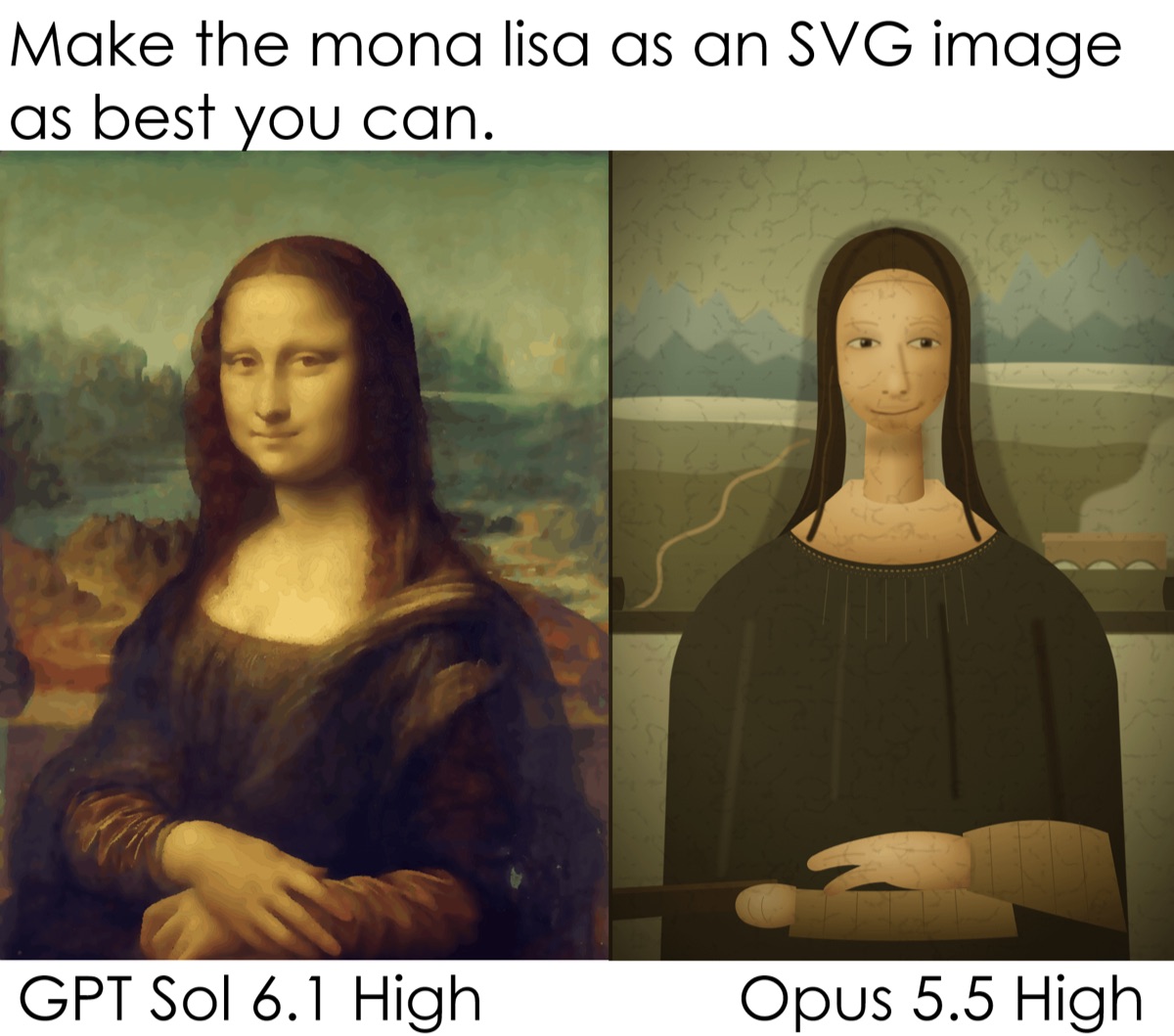
Opus 5.5 was asked to draw the Mona Lisa in SVG (a picture file format drawn in code). A rule said not to find or trace a reference image, and to draw only from what it knows. At a high thinking level it took over 15 minutes, and the picture included the landscape, the hands, and even the smile.
Without seeing a single photo, it can draw the composition, the landscape, and even the shapes of the hands in code alone.
#154 · Opus 5.5 · New cases
With Opus 5.5, depth maps (pictures that store distance in black and white) were applied to several PNG image layers, and 3D objects such as a sword and a thick card border were added to make a Dark Souls-style hologram card. On screen, you can drag the card to turn it and flip it over.
Even a flat 2D illustration, mixed with 3D objects, becomes a work with living depth on a web screen.
#155 · Sonnet 5.5 · New cases
The same test of making SpongeBob in the 3D program Blender was given to GPT-6.1 Sol and Sonnet 5.5, and the two results were placed side by side on one screen. The SpongeBob Sonnet 5.5 made moves while standing with its hands on its hips.
Under the same conditions, you can compare the 3D results of the two companies' models directly.
#156 · Opus 5.5 · New cases
A single one-shot prompt on the Opus 5.5 medium setting made a 3D intro in which a muzzle aims at the screen and a camera that has been shot tilts and falls. Film frames come in on that same tilted view and become a gallery carousel, and a halftone print texture covers the whole screen.
When everyone was making motion graphics, a 3D scene where a camera that has been shot leads straight into a photo gallery was made with a single prompt.
#157 · Opus 5.5 · New cases
A developer who has made games for over 20 years set the structure and the method. Claude Opus 5.5 then made the game Gravewake in about 3 hours. The game is free to play. The source is public too.
A developer with long experience sets only the direction. The model then continues to a playable game within a few hours.
#158 · Opus 5.5 · New cases
In the Godot game engine, the app makes a pixel creature entirely in code. It builds the body, limbs, face, color, pattern, skeleton, and motion. A single prompt made about 95%. The finished version runs offline with no pre-drawn pictures.
Within nine types, you can draw up to 100 creatures with different body structures. With chosen traits locked, you can make four moving children from the parents.
#159 · Opus 5.5 · New cases
The pixel-art news broadcast PNN was made with Claude Code's Opus 5.5. 24-hour transmission then started. It covers real news from about 70 feeds, such as world news, technology, sports, and cryptocurrency. The cast members remember their relationships, conflicts, and inside jokes with each other.
By conversation alone, even a person who has never made a broadcast can start an all-day news channel with a schedule and characters.
#160 · Opus 5.5 · New cases
An iPhone app was made with Claude Opus 5.5 in 8 days. One tap records coffee, mood, sleep, running, and one line a day. The Mac screen was never viewed. Claude Code on a Mac mini in another room wrote Swift and ran tests, then sent the simulator screen. The screen was viewed on a phone, and the app was fixed there.
The life-log app has no account, no ads, and no streak pressure. Data stays only on the iPhone. It was finished while the development screen was viewed only on a phone.
#161 · Opus 5.5 · New cases
The browser game MACH RUN was made from a single prompt. It uses semi-realistic flight physics and flies through a valley that changes constantly. You pass under bridges, land on an aircraft carrier, and build a score. When you pass 135 m, missiles chase you.
There is no worry about procedure or fuel. Only the fun of flight remains. One conversation lets you play the endless game directly in the browser.
#162 · Opus 5.5 · New cases
Papermorph is a skill (a bundle of tasks you use repeatedly) that takes a PDF. It makes a web book you can browse. The path passes through a book plan, a storyboard, narration, animation, and a quiz. It now runs with only Opus 5.5 and the skill, with no image model.
You put in one book. The model then makes a web book with a teaching video and a quiz.
#163 · Opus 5.5 · New cases
A 3D island was made so you feel the gap between companies instead of a bar chart. One building is one company, and a taller building means a larger market capitalization. It was built with React and Three.js (react-three-fiber, a tool that draws 3D in the browser). AI also made the music as instructed.
The table of numbers was removed. You see the difference in company size directly as the island's skyline.
#164 · Opus 5.5 · New cases
HD-2D means pixel pictures placed on a 3D background. Claude Opus 5.5 was asked to make an HD-2D game in one pass. It immediately built a game engine and a small demo map. Day, night, and the weather change. A map editor and action role-playing combat (playing a role while fighting in real time) were each added with one request.
You can write a new game engine, then add a world, an editor, and combat. Each step continues with one request.
#165 · Opus 5.5 · New cases
The code for the app version that will update next was put in. Claude Opus 5.5 then made a motion-graphics video in one pass.
You only hand over the app code. Motion graphics for release then appear in one pass.
#166 · Opus 5.5 · New cases
Claude Opus 5.5 made a Roblox game from a single prompt and a rough game idea only. It handled all of the game design, modeling, map, screen (UI), script, and thumbnail.
In the environment you use now, you can make up to 8 games like this in one day.
#167 · Opus 5.5 · New cases
The 3D pixel-art game Emberfall was made with Opus 5.5. The title screen says Lumina HD-2D engine demo (a method that places 2D pixel pictures on a 3D background and light effects). A village, a bridge, grass thickets, and floating lights are visible.
With one model, you can make a game screen on the web 3D tool Three.js that even includes light and blur effects.
#168 · Opus 5.5 · New cases
Valorant was made playable inside League of Legends with Opus 5.5. The video shows a browser screen. The screen tours the League of Legends map between the turrets from Valorant agent Breach's viewpoint.
This means the model can make a scene you can play directly. To make it, the model moves one game's character and viewpoint onto another game's map.
#169 · Opus 5.5 · New cases
Opus 5.5 was asked to make a very realistic betta fish for use as a Mac wallpaper. A betta is an ornamental fish with long fins. The fish is on the wallpaper, on a black background. Its long red and blue fins look alive, even in the grain.
You can ask in words and get a picture for your own computer screen. You do not need drawing skill or a photo.
#170 · Opus 5.5 · New cases
This is a fan project that remade Terraria in 3D. Terraria is a 2D sandbox game where you dig and stack blocks and fight bosses. With Opus 5.5, the project made its own engine. The project added 3,300 or more items and 313 kinds of enemies and bosses. The project also made all pictures, sound, and music in code.
One person made a game with the model in 8 days. You can play it from the beginning to the end, including boss fights.
#171 · Opus 5.5 · New cases
Opus 5.5 was asked to put Minecraft into Red Dead Redemption 2. The scene shows protagonist Arthur Morgan on a cliff. He builds a small house with blocks and looks at the sunset.
You can also try asking in words to put another game's building rules into an existing game.
#172 · Opus 5.5 · New cases
Opus 5.5 was asked to put Minecraft into GTA 5. Then a Nether portal, a door to another world in Minecraft, appears in the city of Los Santos. A Creeper, a monster that approaches and explodes, wanders between the cars. A Piglin, a pig-shaped monster, appears under an elevated road, and everything catches fire.
You can start by asking in words to mix two different games.
#173 · Opus 5.5 · New cases
The maker asked Opus 5.5 to build an Attack on Titan game inside Minecraft. It took about 1 hour and less than $25 from start to finish. The game is multiplayer, and the screen shows the title TitanCraft and a campaign menu.
Making a whole game now takes about an hour of chat and the cost of a lunch.
#174 · Opus 5.5 · New cases
The maker built this hex-tile island-building game with Opus 5.5 over dozens of prompts. A lone castaway on a deserted island expands the land and gathers resources. When the castaway reaches the lighthouse, a new castaway arrives on the island.
The work has no name yet, but it already has the basics of a game: card choices, goal guidance and a resource display.
#175 · Opus 5.5 · New cases
Opus 5.5 used more than 5.6 billion tokens (the units of text an AI reads and writes) over 48 hours to draw an Airbus A380 airliner as an SVG (a picture format drawn with code). It is a true SVG with more than 600 parts. The screen has step-by-step buttons from gate departure to takeoff, and controls for doors, cross-sections, engines and lights. The model was still reviewing and fixing the drawing when the post went up.
For almost two days, the model reviewed and fixed its own work, and it grew a drawing of 600 parts into a moving airplane.
#176 · Haiku 5.5 · New cases
Haiku 5.5 made a 3D card with the look of a hologram (a shimmering, rainbow-colored 3D effect) where light spreads across the surface. On the screen, a card with a purple character floats at a tilt. The list below lets you switch to other cards.
The smallest and cheapest model can also make a 3D screen effect that stands out.
#177 · Opus 5.5 · New cases
The author used Opus 5.5 to test how closely vibe coding (telling an AI in words to write the code) alone can copy the screen and controls of Age of Empires. The strategy game on screen has a resource bar, a villager info panel, a minimap, and a dock with ships by the water.
It shows that spoken instructions can make a game look and feel like a well-known strategy game.
#178 · Opus 5.5 · New cases
Opus 5.5 made a fighting game in the style of Street Fighter 2. The fighters are AI company CEOs. The character select screen has twelve pixel-art face slots, lines for each person, and a list of special move inputs.
One model can make the full look of a fighting game, with a select screen, lines and move names.
#179 · Opus 5.5 · New cases
The user gave instructions to Opus 5.5, and it made a night coin laundromat scene in the 3D program Blender. The user did not operate Blender by hand. Prompts built the whole scene.
You can build an indoor scene with washing machines, a bench and a blue bucket under fluorescent lights using words alone, with no 3D program operation.
#180 · Opus 5.5 · New cases
Opus 5.5 made a small world with mountains, a waterfall and a lake inside a glass box. You grab and squeeze a cloud to make rain, and you shake it to make lightning. You can paint wind with a wind brush. Day and night and the seasons also change.
You can make a 3D toy through conversation. It does not stop at a picture to look at: you play with the weather by hand.
#181 · Opus 5.5 · New cases
In this village game, you take back your family shrine from yokai. You purify yokai, do favors, cook and fish, and repair the shrine. As your Japanese study progresses, you gain more yokai friends and the shrine is restored. The game also has spaced repetition (a review method like Anki) that shows words again when you are about to forget them.
Suno made only the background music, and Opus 5.5 made everything else. This shows that one person can build a learning game that fits their own study.
#182 · Opus 5.5 · New cases
A solo developer makes a small city-building game in Godot (a free game engine). With Opus 5.5, the developer rebuilt the building creation process. Before, one building needed eight steps. Now ChatGPT draws one concept image, and Claude writes a short Blender (3D program) script that makes the model without a screen.
Dropping a bad way of working saves a solo game developer more time than using stronger tools harder.
#183 · Opus 5.5 · New cases
Transport Fever 3 had no DLSS frame generation (a technique where the graphics card makes in-between frames and inserts them). Opus 5.5 built a mod in under 2 hours. The mod connects to the game's renderer (the part that draws the screen) and passes it the data it needs. On the author's RTX 4050 laptop, FPS doubled.
Users can ask a model to add a feature the game company did not include. This gives low-spec PCs a way to run games more smoothly.
#184 · Motion · New cases
The author made it in Claude Motion, now in beta, with the ISO-GLOW skill (a guide that tells the AI how to do a specific task). The video shows the seven steps from sending a question to Claude to receiving the answer, as 3D illustrations. The first scene shows text sent from a laptop to the model.
A video that explains how complex AI works can be made directly in the browser, with no separate video editing tool.
#185 · Opus 5.5 · New cases
The poster asked Opus 5.5 to make a video about whether an AI is conscious. The screen shows a bar for the probability of the next word, a countdown timer and subtitles. The post does not say who made the dark living room scene.
You can see for yourself how an AI turns a question about its own existence into one video.
#186 · Opus 5.5 · New cases
Opus 5.5 made a mod (an extra file that adds content to a game) for Metro 2033 Redux. The mod adds 7 new weapons. It also adds a lean-out-from-cover move and an armor merchant at the Armory station from the original game. The video shows a screen where the player attaches a scope to a weapon.
The model made a mod that adds new weapons, a new move and a merchant to an existing game, and it used only medium reasoning effort.
#187 · Opus 5.5 · New cases
The video assumes that Malaysia attacks Indonesia over haze (wildfire smoke). Opus 5.5 made it on HyperFrames, with a simulation clock, a map, fighter jet position markers and captions. The post states clearly that this is a fictional simulation and not a real event.
You can also give the model the job of making a scenario simulation video with a map, a clock and captions.
#188 · Opus 5.5 · New cases
Opus 5.5 made an east-west route across the US for a clicker game (a game you play by pressing the screen) that the author is working on. The route holds 5,285 km of real roads from the public map OpenStreetMap, with a point every 10 m. The game screen in the video is the author's own game. The model made only the route.
The model can do the tedious work of downloading map data and placing dense points along a road, and you can use the result as a road in your game.
#189 · Opus 5.5 · New cases
The author asked Opus 5.5 for a simulation (a mock experiment that follows a fictional situation step by step) of what happens if Singapore takes Batam island. The map in the video shows a simulation clock set to Day 1, 05:15, and the situation around the Barelang Bridge in time order.
The model turned a complex fictional scenario into a map and a timetable that you can follow at a glance.
#190 · Opus 5.5 · New cases
I asked Opus 5.5 for a Minecraft ore minecart that carries its own rails. The rails wrap around the cart like a hamster ball. The cart rolls across the sea, passes over a lava lake in the Nether (the underworld), and tunnels through a mountain.
You can ask in words for a vehicle that goes anywhere without laid rails, and put it into the game.
#191 · Opus 5.5 · New cases
I asked Opus 5.5 to build a macOS app that assigns different actions to mouse buttons. The result, Naga Studio, has a settings window that changes the action of each of the 12 side buttons one by one.
You can describe an app that fits your own mouse and build it right away, without searching for a tool you like.
#192 · Opus 5.5 · New cases
This motion video copies the night lamp screen of the Platen app. The paper texture, lamp light, type movement and keyboard are all drawn in code, and the text is newly written. There are two versions, English and Korean. The Korean version even recreates how jamo (Korean consonants and vowels) combine one character at a time.
The original design is Platen by Jerry Munyoka Nkongolo, and the sound is from Epidemic Sound. Opus 5.5 handled motion and direction, and recreated the mood of the app screen with code alone.
#193 · Opus 5.5 · New cases
The author wrote code with Claude Opus 5.5 and built a fantasy RPG with two sons. Every character is Jumper, an open-source crab robot, and several players can join and play together. The crabs' walks and dances are real robot motions trained in MuJoCo (a robot physics simulator). The art and icons come from image generation AI from OpenAI and Google. Free asset packs fill the town and forest 3D models.
You can put motions that a real robot learned directly on game characters and make a game world to play in with your children.
#194 · Opus 5.5 · New cases
This is a game prototype (an early test version) where a character walks through a snow-covered Plaza de Mayo in Buenos Aires. ChatGPT made the sketch. Marble made the background as a Gaussian splat (a 3D method that captures a real space like a photo). Meshy did the character modeling and rigging. Opus 5.5 tied these parts into a game in one shot.
Each AI tool handles the part it suits: art, background and character. Opus 5.5 joins them into a game in one pass, and a working screen takes 30 minutes.
#195 · Opus 5.5 · New cases
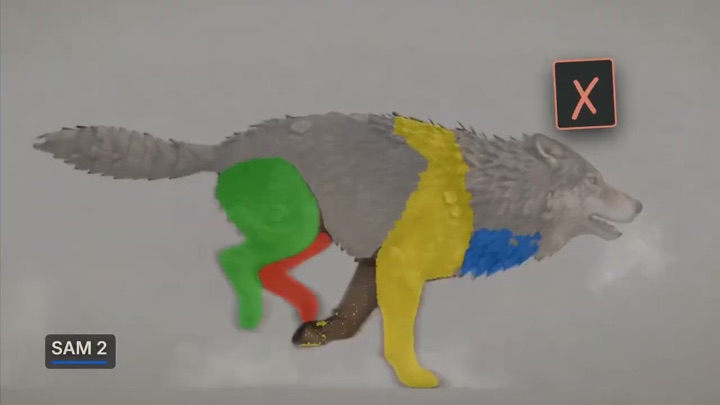
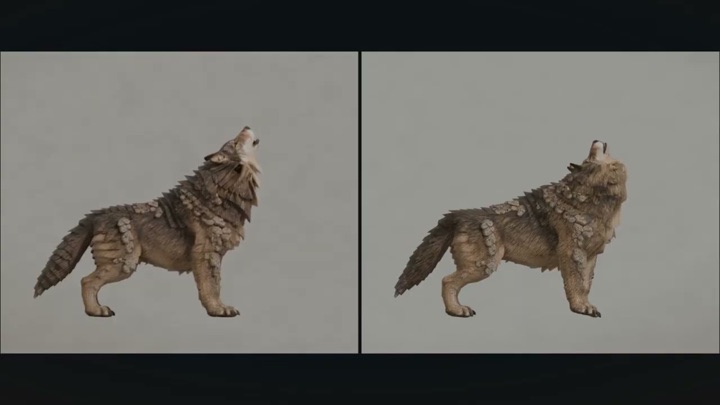
The tool finds every joint in a monster video made by the video AI Seedance 2.5. It then applies the motion to the monster's own skeleton in Blender. Seedance made the video, Tripo made the 3D model, UniRig made the skeleton, and Meta's DINOv2 read the joints. The author and Opus 5.5 built the tool together.
People have motion capture (a technology that records body movement), but monsters did not. Now applying motion to a monster takes minutes.
#196 · Opus 5.5 · New cases
In Claude Code, Opus 5.5 worked for about 2 days and used three.js (a 3D library for browsers) to build an ancient Greek world. It has temples, statues, 57 waterfalls and 149,000 trees. Code generated the buildings, textures and trees. A person prepared the 9 AI-generated reference images that served as the target.
55 subagents (helper AIs that each handle a separate task) wrote about 45,000 lines of code. They compared their work with the reference images and fixed it themselves. The result is a 4K landscape with no image files.
#197 · Opus 5.5 · New cases
Opus 5.5 worked for more than 15 hours and wrote the code, line by line, for Gus & Spark, a 25-minute animation. It used no AI-generated video, not even one shot. The code runs to 34K lines. It used 986M tokens (the units of text an AI reads and writes) and cost about $370 in API fees.
It shows that code alone, with no video generation AI, can finish a full TV episode of 3D animation.
#198 · Opus 5.5 · New cases
The author used a tool called Melty with Opus 5.5 to test merging favorite games. The screen shows Minecraft brick paths, ladders and item slots in a GTA 5 city. The video chapter list also includes an attempt to mix Elden Ring and Counter-Strike 2.
It shows that you can give a model the job of mixing elements of different games on one screen.
#199 · Opus 5.5 · New cases
The author used Claude Opus 5.5 to port the classic shooter Doom to the legendary Casio F-91W wristwatch. A port is a move that lets a game run on another device. The photo shows a Doom scene with a corridor, an enemy and a gun on the small black-and-white screen of a watch on a wrist.
With the model, the author ported a 3D shooter to an old digital watch with a small black-and-white screen.
#200 · Opus 5.5 · New cases
This explainer video was made with Opus 5.5. The screen shows large text, "$5 trillion" and "30 days", with Chinese subtitles. The subtitles ask why the boss of a rich company feels the firm could fail every day. The author wrote that their heart raced when the video was done.
The author found the method useful for explainer videos, enough to feel they could start a video account with it alone.
#201 · Opus 5.5 · New cases
A custom engine built with C++ and Metal (Apple's graphics technology) loads OpenMapTiles, public map data, and draws the whole Earth as an open-world game. It has Earth-scale weather, interiors generated automatically for each building, and vehicles such as skateboards and snowboards. The author gave Opus 5.5 work all day on three Macs at home.
The project has systems but no game rules yet. Still, one person grows it to this scale by checking the model's work each day and assigning the next task.
#202 · Opus 5.5 · New cases
The author has kept one Claude Code chat going for 20 days without a break. They are building a squad combat game with only Opus 5.5 and Three.js, a 3D web library. They have not read a single line of code. The screen shows squad chat, a scoreboard, a map and BR-9 Carbine weapon info. The author did not use Blender.
The game is still in progress. In this case, the author has grown a game for 20 days through conversation alone, without reading code.
#203 · Opus 5.5 · New cases
The author used Opus 5.5 in Claude Code to build a sunset ocean renderer from scratch with WebGPU (a technology that uses the graphics chip directly in the browser). It uses no game engine or graphics library. It draws FFT (a method that computes waves from frequencies) waves, white foam, sun glitter and a cloudy sky. You can fly around freely. Open one compressed 61KB HTML file in Chrome.
A single file in the browser can run an ocean with realistic waves and sky, without a heavy engine.
#204 · Opus 5.5 · New cases
The author used Opus 5.5 to make a video that asks how individual investors were soothed while the Chinese stock market fell from 6124 to 1660 in 2008. The title text appears over ink-style mountains and a figure on a cliff.
Turning a past event in the stock market into a pictorial video took 2 hours.
#205 · Motion · New cases
The author used Claude Motion to animate an infographic (a diagram that shows information as a picture) of a work process. The author wrote that they could not finish this job in the video program After Effects a year and a half ago. This time they did it with a few lines of text.
You can make an animated diagram for a presentation with a few lines of text, even if you lack video production skills and gave up before.
#206 · Opus 5.5 · New cases
Claude Opus 5.5 wrote all of a QEMU emulator (a program that imitates the hardware of another device in software) for the HTC HD2, which uses the Qualcomm QSD8250 chip. No human reviewed the code. It boots like a real phone from an unmodified 512 MiB NAND (phone storage chip) image. A setup wizard, a settings screen and a 3D test on the graphics chip (GPU) appear.
The model can build a hardware emulator that boots real phone storage as it is and draws 3D, even when no human reviews the code.
#207 · Opus 5.5 · New cases
The author gave the model only the raw footage: an iPhone 4S unboxing video filmed in November 2011. Opus 5.5 edited the video and added a cute ending.
If you give the model only the footage, it edits old videos that you filmed long ago.
#208 · Opus 5.5 · New cases
The author made an animation with the character Clawd using Opus 5.5 Ultracode. The author wrote that they improved the sound effects (sfx). The main frame shows a monitor full of code on a desk by a rainy window. A small orange character sits at the keyboard.
This is an improved version of the same animation, posted again. It shows how to raise the quality of a model-made video by refining even the sound.
#209 · Opus 5.5 · New cases
The author ran Opus 5.5 at the Extra High setting in Claude Code (a coding AI used in the terminal) for 3 hours. It found and fixed 4 performance bugs that the author had missed. Large chats open 27% faster. Going back to the previous screen is 2 times faster. Scroll jumping dropped by 98%. A chat that loaded twice on refresh now loads once.
One prompt that tells the model to measure the speed before and after each fix lets you find bottlenecks that people missed and confirm them with numbers.
#210 · Opus 5.5 · New cases
A physicist wrote that Opus 5.5 did a quantum gravity calculation (a theory that tries to explain gravity with quantum mechanics) in 10 hours. The physicist had spent a year on about 500 pages of hand work for a doctoral thesis. Opus 5.5 also wrote the paper and a GitHub repository. The result is in the GitHub repository linked in the post.
Opus 5.5 redid a calculation that a person worked on for a long time, in a short time. It also found errors, and the final result did not change.
#211 · Opus 5.5 · New cases
The author used Opus 5.5 to design a website concept for a small coffee shop, Strawberry Corner. The screen shows a menu page with 8 strawberry drinks and desserts as cards with prices, and a hand-drawn style cafe building.
One website design can capture the mood of a shop that makes customers want to come back.
#212 · Opus 5.5 · New cases
The author used Opus 5.5 to build a huge world from scratch inside the game engine Unreal Engine. A scene in the video shows a sunlit forest path and a figure walking between red flags.
The author showed that one model can now build a 3D world at a scale that was not possible last year.
#213 · Opus 5.5 · New cases
The author used Opus 5.5 to build Voltane, a game about RC cars (remote-controlled toy cars). The work started around September 20 and took less than a month. The beta launched about 10 days ago. It adds a campaign mode, an offline mode and local split screen for online mode.
A developer with 20 years of coding experience can now ship a game full of features in under a month.
#214 · Opus 5.5 · New cases
The author, who makes a game, used Opus 5.5 to create character animation and showed it in a video. The screen shows a low-poly (simple 3D with few faces) scene where a figure in armor and a group carrying boxes walk around.
The model can take on animation, which needs much manual work in game development, and this speeds up development.
#215 · Opus 5.5 · New cases
A user gave Opus 5.5 one 20-second video. The model rebuilt the whole video as one piece of GLSL code (a programming language that graphics chips use to draw the screen). The code is 156KB. It loops without a break and uses only formulas, with no textures (surface image files) and no video frames.
This means a formula alone can produce the same scene as a video, without a video file.


#216 · Opus 5.5 · New cases
The author is making a realistic space game in Unreal Engine, inspired by Outer Wilds, where the player explores fictional planets. Opus 5.5 wrote the C++ code, the shaders (programs that draw the texture and light of the screen) and the tools that generate the planets. The author set the direction, tested the game on a Windows PC and reported what felt wrong.
The game is still at an early stage. The human handled direction and testing and the model wrote the code. The planet exploration game is far enough along to share as a Windows installer and source code.
#217 · Opus 5.5 · New cases
The author started this work to test what Opus 5.5 can do. The author used the Godot game engine and the 3D program Blender to make an open-world sandbox demo. It has NPC (game character) daily routines, changing weather, day and night, and wild animals and enemies that move. As the systems grew complex, the author also vibe coded (wrote code by giving instructions in plain language) separate control screens for dialogue, quests and assets (the images and models used in a game).
A test grew into one RPG demo in which many systems run together.
#218 · Opus 5.5 · New cases
Karen Warfare is a first-person shooter that Opus 5.5 built in one day with Three.js (a 3D tool for web browsers). The video shows a sniper scope, 8:03 time left, a 17 to 18 scoreboard, a navigation map, a list of character names and dialogue subtitles.
One day is enough to build the screen layout and the mood of a small indie game.
#219 · Opus 5.5 · New cases
The model changed the TV screen to look like a Game Boy Color and turned the home screen into a Pokémon town. When you enter a building, an app opens. To change settings, you must first beat a gym leader.
A plain TV menu can become a game town that you walk through with the remote.
#220 · Opus 5.5 · New cases
This retro-futuristic game combines real-time strategy (RTS) and first-person shooter (FPS). The developer built it over a few days with Opus 5.5 in Claude Code (an AI tool that writes code in the terminal). The video shows a top-down strategy screen where the player builds a power plant and barracks and grows tanks.
One person can start combining two favorite games from different genres into one game in a few days.
#221 · Opus 5.5 · New cases
Opus 5.5 modified the Google TV home screen over ADB (a tool that controls an Android device from a computer) and WiFi. Memory use dropped from 282MB to 96MB compared with the original screen. It has no ads. It shows popular recommendations from the TMDB API and crypto prices from the Binance API. It also has a theme that darkens by itself at dusk.
It shows that you can replace the default screen of a TV you already use with a lighter one that has the features you want.
#222 · Opus 5.5 · New cases
Opus 5.5 makes the deep-sea creature field guide website Abyss Atlas from a single prompt. Creatures such as the vampire squid can be rotated and viewed through 360 degrees. The website includes species names, habitat descriptions, and a list screen together.
The author wrote that a year ago a 3D artist and a developer had to spend two weeks on this work. Now, beyond a flat screen view, a single request makes even 3D, motion, and control.
#223 · Opus 5.5 · New cases
Opus 5.5 uses Blender MCP to put a skeleton in a first-person hand and an MP5 submachine gun. Blender MCP is a connection method that lets Claude operate the 3D program Blender directly. Opus 5.5 sets the pose of the hand and the gun. Opus 5.5 makes them move. The author wrote that this result can be imported into game engines such as Unity and Unreal.
This shows one model can replace the first-person weapon and hand animation work the author always paid someone to do.

#224 · Opus 5.5 · New cases
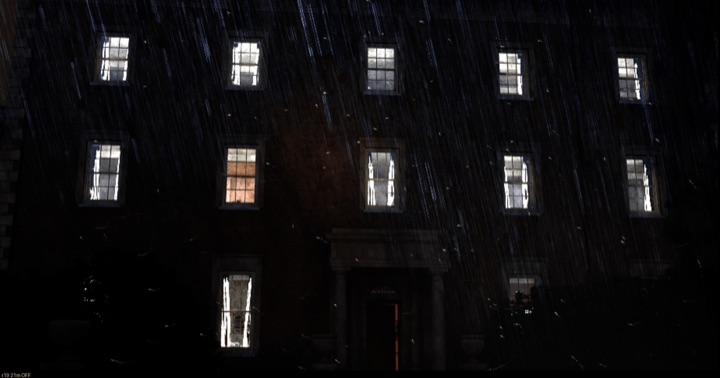
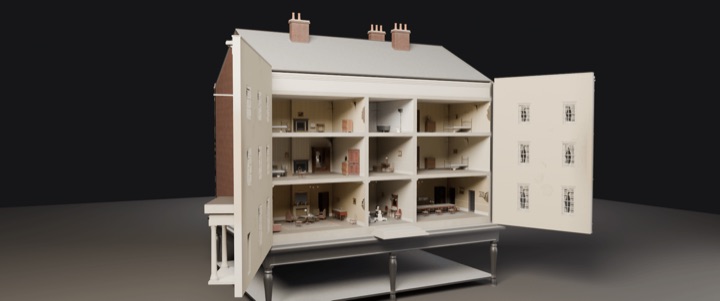
A modeler who has done 3D work since the early 2000s guides Opus 5.5 with prompts and makes a 3D scene. The prompts include reference images, measurements, and revision requests made several times. The post shows a mansion that stands under an evening sky. The post shows a window on a rainy night. The post shows a close-up where even a single strand of fur is visible. The post shows a dollhouse cross-section with the door wide open.
3D modeling is not a one-line request. It is work that accumulates materials and revisions. This shows that when an expert handles it that way, Opus 5.5 makes even detailed scenes.
#225 · Opus 5.5 · New cases
The author wanted short, simple animated images for web design without copyright limits. They built a public gallery, vibegif, with Claude Opus 5.5. At the time of the post, it holds 500 GIFs and animated WebP files (an image format for the web). The goal is more than 1,000.
When you add short animated images to a website design, you can pick one and use it right away without copyright worries.
#226 · Opus 5.5 · New cases
Over a song made by Suno, Opus 5.5 in Claude Code wrote a 22,000-line Python engine in about one week and placed 4,320 frames one by one. The mural runner uses 1,933 images cut and picked from Wan video. The engine changes the pose on every sixteenth note (about 2 frames), so the runner moves like stop motion.
If you fix the beat, gravity and stride length in code, you can match the leaps and landings of a music video with no cuts, frame by frame.
#227 · Opus 5.5 · New cases
The author spent 1 year building a map by hand. On that map, they used Claude Opus 5.5 for 7 weeks to stack 739 commits (records that save each change one by one) and make a 3D game. On screen, a character walks down a village street lined with market stalls, and there is dialogue about a baby dragon.
On a map that a person built over 1 year, the model can continue to build a walkable game of 7 weeks and 739 commits.
#228 · Opus 5.5 · New cases
Opus 5.5 designed an animation in which the screen flows without breaks, and it built the animation as designed. This time the author did not use the design tool Figma at all.
You can build a screen with motion from start to finish through conversation alone, without drawing a separate design file.
#229 · Opus 5.5 · New cases
The author gave Opus 5.5 in Claude Code a photo of a Samsung TV settings screen and a prompt. The model built a small remote with 3 tools, using the way a remote connects over home Wi-Fi. The author attached that remote as a Grok Bot plugin, and a spoken command opened Netflix, scrolled and picked a title.
With no remote or phone, one spoken sentence makes the TV open and pick apps by itself.
#230 · Opus 5.5 · New cases
Claude Opus 5.5 edited a birthday greeting video for Prabhas. The materials were a sample video that a person supplied, a full film and a full song.
If you hand over a full film and a full song, you can leave the editing of a birthday greeting video to the model.
#231 · Opus 5.5 · New cases
The author used Claude Opus 5.5 and the colorfigures skill to build an interactive site for learning drone engineering. Users assemble 13 real aircraft part by part, such as frame, motors and wiring. The types include 5-inch freestyle, cinewhoop, racer, flying wing, VTOL and heavy-lift octocopter. Then they fly each one in first-person FPV (the view from on board) at 13 airfields.
You do not need to crash a $400 FPV aircraft to learn. You can learn how drones are built by assembling and flying in the browser with no sign-up.
#232 · Opus 5.5 · New cases
Beerus from Dragon Ball Super inspired the author to rebuild a runner game that honors Paozu Mountain from the first episode of Dragon Ball. They made it with Opus 5.5 and Crayon, which is based on Three.js. You can play it right in the browser.
One favorite scene can inspire a fan game, and conversational coding can put it in the browser right away.
#233 · Opus 5.5 · New cases
The author used Opus 5.5 and Three.js (a tool that draws 3D in a web browser) to build Every Joule, a 3D energy book that students learn from by touching. This time the author added nine lessons. The book now covers the whole energy unit of GCSE, a UK secondary science exam, from kinetic, gravitational and elastic energy to heat, power, efficiency, energy resources and conservation of energy.
A textbook that stayed with text and flat pictures can become a 3D teaching resource in which students predict and check for themselves.
#234 · Opus 5.5 · New cases
The author ran all of Mario 64 in mixed reality (a technology that overlays a virtual screen on the real world). It runs in real 3D, not a fake stereoscopic effect, at 90 frames per second. The game floats above a desk, and the player uses a controller. The author wrote that using Opus 5.5 with PICO CLI (a tool for PICO devices) made the work fairly easy. The game is based on a genuine cartridge the author owns. It is a personal project with no link to Nintendo or PICO.
Running an old 3D game in true stereoscopic 3D on a mixed reality device is now a task one person can try.
#235 · Opus 5.5 · New cases
The author used Three.js (a JavaScript tool that draws 3D in the browser) and Opus 5.5 to draw one human eye in real time in the browser. A line at the bottom of the screen says it was made with Three.js and Opus 5.5. The author wrote that this one eye took 7 days. It uses no textures (surface images), 3D models or photos. It uses only math, light and about 400 parameters (adjustable numbers that set the shape).
It shows that a browser can draw a detailed subject like a human eye with only formulas and adjustable numbers, and no image files.
#236 · Opus 5.5 · New cases
The default home of a rooted Samsung S90D OLED (Tizen 9, 2024) became a Control Center with only a clock, the date and the apps in use. The model turned off 41 preinstalled apps instead of hiding them. The home button returns in about 0.45 seconds. At each boot, a script applies the same settings again.
It replaced the Samsung home, with its ads, recommendation rows and TV Plus, with a screen that stays the same after a reboot.
#237 · Opus 5.5 · New cases
The author wanted an AI to be the game master when playing Dungeons & Dragons with the kids. They built a program that does that job with Opus 5.5.
A model that people direct in conversation can even run a tabletop game that kids play together.
#238 · Opus 5.5 · New cases
Opus 5.5 started from an empty folder with a prompt and a few CleanMyMac screenshots. It built Cleanly, a free open-source cleaner app that runs on Mac and Windows. One click removed 14.6GB of clutter. The person wrote no code by hand.
If you choose the screens and give reference videos, a real PC app arrives in one afternoon, with safety checks and an installer.
#239 · Opus 5.5 · New cases
The author gave one reference photo and asked the model to take every part apart in code. Opus 5.5 built the shell, gears and hoses in Three.js. Before it made the video, it placed the render beside the photo and matched it 3 times. Under the large gear are 260 pistons, hoses, screws and wires.
If you keep the 3D workflow in one skill, you can make up to 7 machine teardown simulations from single photos in two days.
#240 · Opus 5.5 · New cases
Opus 5.5 received a one-line request to make a model and one photo. It built a robot octopus in three.js (code that draws 3D on the web). Before it touched the video, it fixed the still scene beside the photo 3 times to close the gaps. The 8 arms hold 202 links (joints that connect the arms) and 480 wheels. The 25-second video has 2,616 lines of code. At 16 seconds, the whole octopus scatters on a platform that turns 330 degrees. It reassembles before the turn ends.
From one photo and a short line, code produces a robot that scatters whole and then joins again.
#241 · Opus 5.5 · New cases
Opus 5.5 built Rackline, a warehouse scene with moving forklifts, from the SimReady 3D models that NVIDIA released for free. The author shrank 2,595 models for the browser and uploaded them to Hugging Face (a site for sharing AI resources). The total size fell from 225GB to 3.8GB.
One V8 engine model fell from 888MB and 9 seconds to 9.3MB and 0.6 seconds with the same look, so heavy public 3D models can work on the web right away.
#242 · Opus 5.5 · New cases
The author built 3D pixel games with Opus 5.5, published the source code and put them online to play in the browser. The video shows Tie-Break, a clay court tennis game seen from an angled top view. The post says the concept came from another creator's work.
The code and the play links are both open, so anyone can play and build the same way.
#243 · Opus 5.5 · New cases
The author ported the Nintendo game Mario Kart World to run on Sony's handheld console, the PS Vita. The video shows a race on the Vita screen. The author wrote that the work took 20 hours with the help of Claude and Opus 5.5.
One person ported a recent game to an older handheld device, long past its prime, in less than a day of work.
#244 · Opus 5.5 · New cases
The author used Opus 5.5 to build an Earth simulator (a program that models the real Earth) where you fly anywhere in the world at Mach 20 (20 times the speed of sound). This time the author focused on realistic scenery, seasons, weather and time of day. The place in the video is Chamonix in the French Alps, covered in snow in December.
You can view any place in the world from the sky in the season, weather and time of day you choose. You can also use it to think of places to visit.
#245 · Opus 5.5 · New cases
cinecode is a skill where Opus 5.5 writes the scenario, scenes, sound, and editing all in code and completes the video. A skill is a feature that tells Claude a set way to work. The author assigned this task: make a self-introduction video. This video is the result of that task. The screen shows a train running toward the viewer along a railroad track through a snow-covered forest.
A way opened to make a video with one Claude subscription, even without a separate video generation model.