A Claude Opus 5.5 case · #157
A 3D company island where building height is market capitalization
u/dopestdro ·
The table of numbers was removed. You see the difference in company size directly as the island's skyline.
A Claude Opus 5.5 case · #157
u/dopestdro ·
The table of numbers was removed. You see the difference in company size directly as the island's skyline.
#122 · Opus 5.5 · New cases
A first-person game was built with Three.js, a tool for drawing 3D on the web. You carry a torch and a sword and walk along a village road to a distant castle. It took 40 minutes, including the music and art assets generated with an image generation AI.
Give the model the music and art too, and it makes a game with a real atmosphere in under an hour.
#123 · Opus 5.5 · New cases
Willowmere is a cozy 3D pixel art game. You move to a small seaside town, fix a lighthouse that has gone dark and bring back the lantern festival. It has farming, fishing, cottage decorating, and befriending the residents and a cat, and it also plays right away in a phone browser.
The $20 monthly plan alone is enough to finish a game with plenty to do in a few five-hour sessions.
#124 · Opus 5.5 · New cases
A developer made the trailer for the game they are building with Opus 5.5. In a field that looks cut out of paper and pasted together, a snail with a 'BOB' sign faces a hooded figure holding a 'YOU' sign.
A solo game developer can work with the model to make the video that promotes the game too.
#125 · Opus 5.5 · New cases
A 3D game was made with Opus 5.5 in the style of Nintendo's Splatoon: two teams compete by shooting ink to paint the floor in their color. It has a time-limit timer, a minimap and a special-move button, and anyone can go to the web address and play right away.
The rules and screen layout of a famous console game can be carried over into a game that runs in the browser with no install.
#126 · Opus 5.5 · New cases
Opus 5.5 was given the research paper "Regularized Recursive Self Improvement of Agent Harnesses" and made an 8-minute summary video in the style of the math explainer channel 3Blue1Brown, with shapes and arrows moving on a black screen. The video illustrates how a harness (the execution framework wrapped around an AI so it can do work) analyzes its failures and fixes itself step by step.
Turning a difficult paper into an educational video anyone can watch can be done automatically, with no human work.
#127 · Opus 5.5 · New cases
The user put someone else's prompt into Claude Code almost unchanged and stepped away. Over about 1.5 to 2 hours, it made an explainer video for the meetup app Friendr.nl on its own. It made the script, hand-drawn collage art, voice, music and sound effects, built it all as plain JavaScript animation synced to the speech and exported it as MP4. It also had another model review the draft and fixed the problems that review found.
With just one borrowed prompt, you can get a ready-to-use explainer video for your own service for about $4.
#128 · Opus 5.5 · New cases
This video in the style of an SNES (Nintendo's 1990s game console) game tells the story of Sydney, the 2023 Bing chatbot, fighting Sam Altman and then facing Claude. Several agents (AIs that carry on through multiple steps on their own) split up the characters, music and battle scenes and made everything in code. The user did not provide a single image or sound file.
Character art, background music and battle staging can all be handed off at once, so one person can make a retro game-style video alone.
#129 · Opus 5.5 · New cases
Opus 5.5 was asked to make a game called 'The trolley problem is not a problem'. The trolley problem is the ethics thought experiment where you switch tracks to choose who to save. On screen, a mine cart racing down the tracks smashes whatever blocks its way to build combos. The screen also shows health, gold, 30 sections, the distance left to the boss and a lever for switching tracks.
A one-line game idea that twists a famous ethics problem became a 3D game with health, combos and boss stages.
#130 · Opus 5.5 · New cases
Claude was asked to show what was inside its own mind, and Opus 5.5 made a video. Tiny characters densely fill a dark screen to form golden shapes, and short subtitles run beneath them.
Left to decide how to depict the invisible inside of an AI, the model chose the staging itself and showed it in a single video.
#131 · Opus 5.5 · New cases
A hand-drawn, collage-style animation on the theme 'What is the purpose of life?' was built in pure JavaScript. From a single prompt, Claude Code worked alone for about 1 hour 20 minutes on the script, drawings, voice and animation. Fees for 8 external APIs (channels for borrowing features from other services) came to $3.21, and it used about 10% of the 5-hour usage limit.
Even while no one is at the desk, a short video with everything from planning to drawings and voice can be finished for the price of a cup of coffee.
#132 · Opus 5.5 · New cases
Opus 5.5 made a pixel art scene of an island floating in a rainy night sky. The lit house, the campfire, the pond, and even the bones and crystals underground were all drawn in TypeScript (JavaScript with added type rules) code, and it took about 10 minutes to finish.
A pixel art scene good enough for a game background can be made with code alone, without a single image file.
#133 · Opus 5.5 · New cases
Opus 5.5 was given a gaming laptop, the Unity game engine, the 3D program Blender and external APIs, and left to work on its own for 36 hours. The result was a playable old-school MMO RPG (a role-playing game where many players share one world online). It used 7.85 billion tokens and cost $2,175 for Opus 5.5. A separate $230 went to 2D and 3D art and music generation.
One person can build a game, down to a character creation screen where you pick a race and class, on a single laptop in under two days.
#134 · Opus 5.5 · New cases
The author handed Opus 5.5 a Minecraft mod they had made (an add-on file that adds new features to the game) and only asked for a trailer. The result was an atmospheric trailer video, with scenes like a character standing by a campfire in a forest at dusk.
You don't need to know video production. One mod file is enough to get a video that promotes your mod.
#135 · Opus 5.5 · New cases
Opus 5.5 built an energy drink website from scratch, with colorful drink cans floating in 3D and a screen that changes as you flip through flavors. The video shows the model going beyond writing code: it tests the results itself, finds errors and fixes them. It was also compared with GPT-6 Astra.
Given one design-award-winning site as a reference, the model can carry on from coding through checks and fixes to build a 3D website with plenty to look at.
#136 · Opus 5.5 · New cases
Foldline is a 3D driving game made with Opus 5.5. You drive a car through colorful alleys collecting music notes, listen to in-game radio broadcasts, and change the time of day from dawn to night. The roads curve as if defying gravity.
You can build a charming game with the model that combines several ideas, such as music, time-of-day changes and twisted roads.
#137 · Opus 5.5 · New cases
Given 4 reference images and a first prompt, Opus 5.5 built a 3D roguelite on a 6×6 chessboard by itself, using the Godot engine in Claude Code (a game where you pick a new path each round and grow your pieces). The game code, the 3D models of the chess pieces and arena, and the music and sound effects were all made in code, with no Blender or asset files.
A person can finish a whole game, with graphics, sound and rules, without writing a single line of code.
#138 · Opus 5.5 · New cases
Opus 5.5 made Fallout: New York, a game that plays directly in the browser. It includes quests, dialogue choices, the V.A.T.S. targeting system and a working Pip-Boy wrist device. Buildings, weapons, faces and sounds were all generated in code.
A sizable role-playing game can be filled out with code alone, without a single texture (surface image) file or sound file.
#139 · Opus 5.5 · New cases
Using Opus 5.5 and Three.js (a tool for drawing 3D in the browser), a No Man's Sky-style space game was made from a single prompt. It has more than 80 planets, each with different terrain, minerals, alien creatures and weather, and you can leave the ship and walk around.
A large game that covers everything from flying a spaceship to exploring planets can be made with a single request.
#140 · Sonnet 5.5 · New cases
One request to Sonnet 5.5 produced a battle royale (last-player-standing match) game that resembles Fortnite. The screen carries a label saying under $20, and the real game's screen is placed alongside below it.
A 3D game with a feel quite close to the real game, even when placed next to it, comes from a low cost and a single request.
#141 · Opus 5.5 · New cases
Starting from one prompt, Opus 5.5 wrote about 25,000 lines of JavaScript over about 3 days and rebuilt Pokémon Red from start to finish. With no image files, it drew every pixel in code on a 320×180 screen. The human only played the game through and reported the broken parts.
The full game, with 151 Pokémon, 224 maps, gyms and the Elite Four, can be played directly in the browser.
#142 · Opus 5.5 · New cases
One video was made in the terminal with Claude Code set to Opus 5.5. The author wrote that the visuals and the sound were all made in code, with no image or audio files.
Code alone can produce a video with sound, with no filming, recording or editing software.
#143 · Opus 5.5 · New cases
With Opus 5.5, an iPhone invoice app called QuickSend, a matching introduction website and a motion graphics (animated graphics) launch video were made in one go. The screen shows an invoice list and a window for choosing a payment method.
The app, the website and the promo video can be finished in one conversation with a single model, without assigning each one separately.
#144 · Opus 5.5 · New cases
For a daughter, a pastel pixel art (pictures drawn in small dots) game was made with Opus 5.5, in which you open bamboo steamers to collect soft buns. There are 150 kinds of buns in 13 sets. You travel between towns by train and hot air balloon, and you can also fish, farm and play minigames.
The model made the art assets, the music and the trailer, so a parent with no coding background can finish a game for a child as a single web page.
#145 · Sonnet 5.5 · New cases
Sonnet 5.5 was used to make the chessboard and pieces look like doodles scribbled by hand on paper. On screen, cute pieces such as an owl, a mushroom, and a bee wearing a crown stand on a crayon-like chessboard.
Even an old game with set rules can have its look changed completely and become a work with an entirely different mood.
#146 · Opus 5.5 · New cases
Opus 5.5 made a music video for Astra Blue, a virtual pop star who sings AI news as songs. Only two reference images and the song were put in, in a single request, and Opus 5.5 decided all of the screen direction.
With only a song and two images, you can leave even the scene composition to the model and make a music video.
#147 · Opus 5.5 · New cases
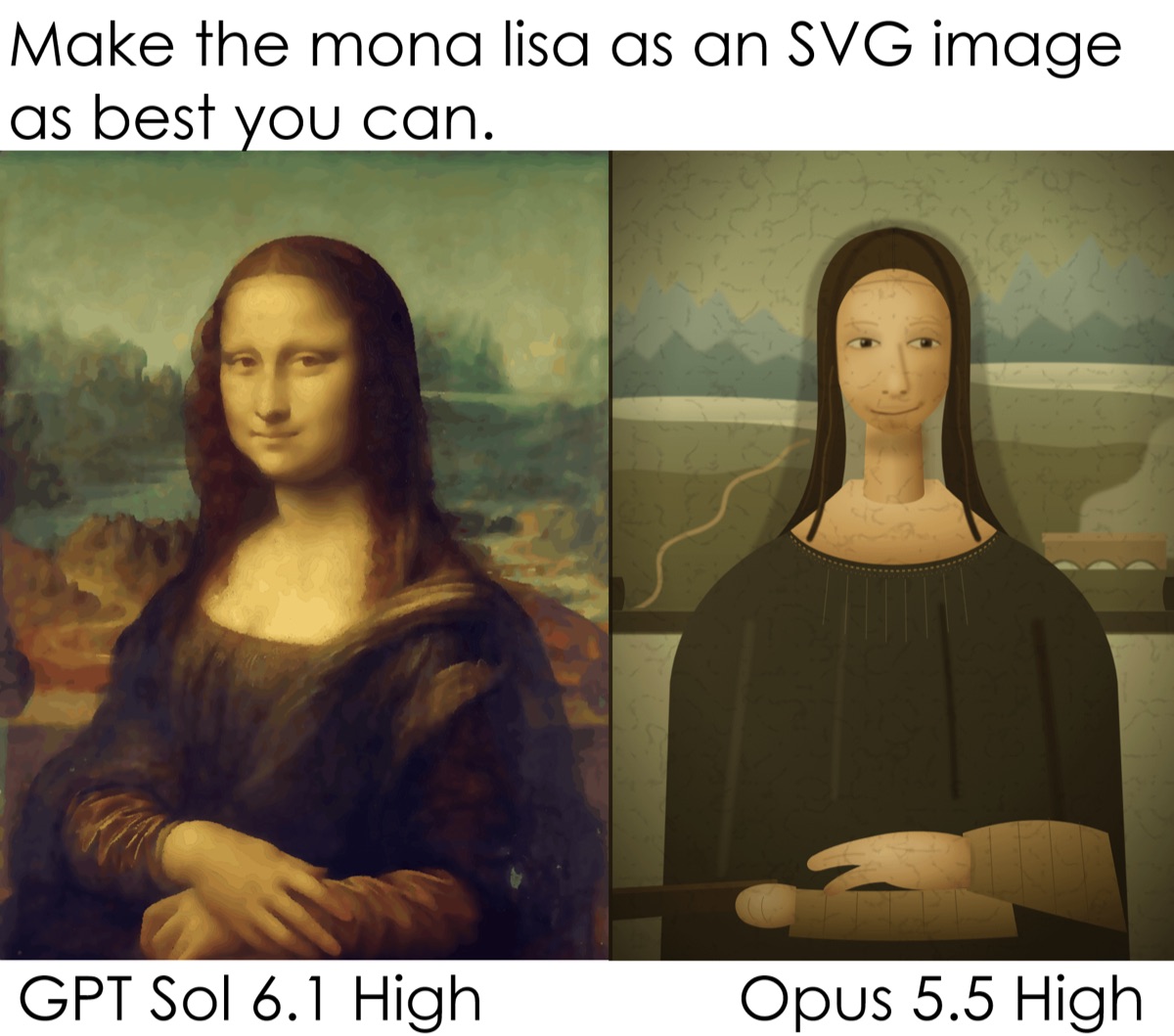
Opus 5.5 was asked to draw the Mona Lisa in SVG (a picture file format drawn in code). A rule said not to find or trace a reference image, and to draw only from what it knows. At a high thinking level it took over 15 minutes, and the picture included the landscape, the hands, and even the smile.
Without seeing a single photo, it can draw the composition, the landscape, and even the shapes of the hands in code alone.
#148 · Opus 5.5 · New cases
With Opus 5.5, depth maps (pictures that store distance in black and white) were applied to several PNG image layers, and 3D objects such as a sword and a thick card border were added to make a Dark Souls-style hologram card. On screen, you can drag the card to turn it and flip it over.
Even a flat 2D illustration, mixed with 3D objects, becomes a work with living depth on a web screen.
#149 · Sonnet 5.5 · New cases
The same test of making SpongeBob in the 3D program Blender was given to GPT-6.1 Sol and Sonnet 5.5, and the two results were placed side by side on one screen. The SpongeBob Sonnet 5.5 made moves while standing with its hands on its hips.
Under the same conditions, you can compare the 3D results of the two companies' models directly.
#150 · Opus 5.5 · New cases
A single one-shot prompt on the Opus 5.5 medium setting made a 3D intro in which a muzzle aims at the screen and a camera that has been shot tilts and falls. Film frames come in on that same tilted view and become a gallery carousel, and a halftone print texture covers the whole screen.
When everyone was making motion graphics, a 3D scene where a camera that has been shot leads straight into a photo gallery was made with a single prompt.
#151 · Opus 5.5 · New cases
A developer who has made games for over 20 years set the structure and the method. Claude Opus 5.5 then made the game Gravewake in about 3 hours. The game is free to play. The source is public too.
A developer with long experience sets only the direction. The model then continues to a playable game within a few hours.
#152 · Opus 5.5 · New cases
In the Godot game engine, the app makes a pixel creature entirely in code. It builds the body, limbs, face, color, pattern, skeleton, and motion. A single prompt made about 95%. The finished version runs offline with no pre-drawn pictures.
Within nine types, you can draw up to 100 creatures with different body structures. With chosen traits locked, you can make four moving children from the parents.
#153 · Opus 5.5 · New cases
The pixel-art news broadcast PNN was made with Claude Code's Opus 5.5. 24-hour transmission then started. It covers real news from about 70 feeds, such as world news, technology, sports, and cryptocurrency. The cast members remember their relationships, conflicts, and inside jokes with each other.
By conversation alone, even a person who has never made a broadcast can start an all-day news channel with a schedule and characters.
#154 · Opus 5.5 · New cases
An iPhone app was made with Claude Opus 5.5 in 8 days. One tap records coffee, mood, sleep, running, and one line a day. The Mac screen was never viewed. Claude Code on a Mac mini in another room wrote Swift and ran tests, then sent the simulator screen. The screen was viewed on a phone, and the app was fixed there.
The life-log app has no account, no ads, and no streak pressure. Data stays only on the iPhone. It was finished while the development screen was viewed only on a phone.
#155 · Opus 5.5 · New cases
The browser game MACH RUN was made from a single prompt. It uses semi-realistic flight physics and flies through a valley that changes constantly. You pass under bridges, land on an aircraft carrier, and build a score. When you pass 135 m, missiles chase you.
There is no worry about procedure or fuel. Only the fun of flight remains. One conversation lets you play the endless game directly in the browser.
#156 · Opus 5.5 · New cases
Papermorph is a skill (a bundle of tasks you use repeatedly) that takes a PDF. It makes a web book you can browse. The path passes through a book plan, a storyboard, narration, animation, and a quiz. It now runs with only Opus 5.5 and the skill, with no image model.
You put in one book. The model then makes a web book with a teaching video and a quiz.
#157 · Opus 5.5 · New cases
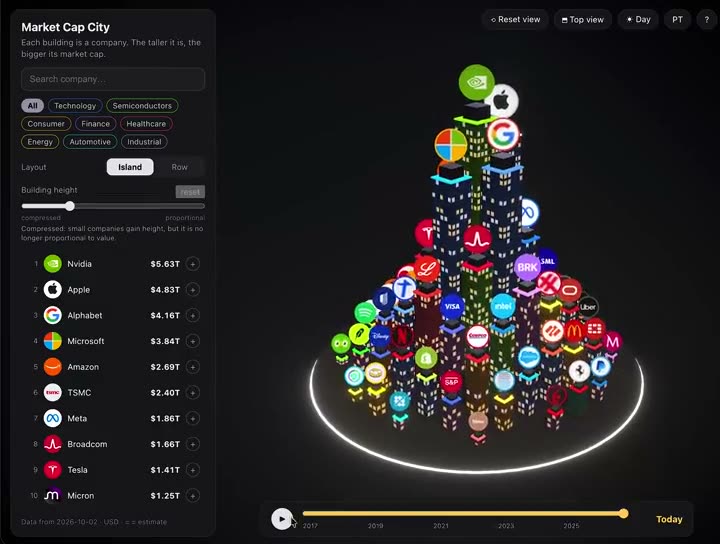
A 3D island was made so you feel the gap between companies instead of a bar chart. One building is one company, and a taller building means a larger market capitalization. It was built with React and Three.js (react-three-fiber, a tool that draws 3D in the browser). AI also made the music as instructed.
The table of numbers was removed. You see the difference in company size directly as the island's skyline.
#158 · Opus 5.5 · New cases
HD-2D means pixel pictures placed on a 3D background. Claude Opus 5.5 was asked to make an HD-2D game in one pass. It immediately built a game engine and a small demo map. Day, night, and the weather change. A map editor and action role-playing combat (playing a role while fighting in real time) were each added with one request.
You can write a new game engine, then add a world, an editor, and combat. Each step continues with one request.
#159 · Opus 5.5 · New cases
The code for the app version that will update next was put in. Claude Opus 5.5 then made a motion-graphics video in one pass.
You only hand over the app code. Motion graphics for release then appear in one pass.
#160 · Opus 5.5 · New cases
Claude Opus 5.5 made a Roblox game from a single prompt and a rough game idea only. It handled all of the game design, modeling, map, screen (UI), script, and thumbnail.
In the environment you use now, you can make up to 8 games like this in one day.
#161 · Opus 5.5 · New cases
The 3D pixel-art game Emberfall was made with Opus 5.5. The title screen says Lumina HD-2D engine demo (a method that places 2D pixel pictures on a 3D background and light effects). A village, a bridge, grass thickets, and floating lights are visible.
With one model, you can make a game screen on the web 3D tool Three.js that even includes light and blur effects.